
25,000 Steps to Kilometers: Exact Distance, Time & Calories Burned
So, your phone or fitness watch is telling you that you hit 25,000 steps today.
Let’s be real your feet are probably screaming right now. You don’t rack up a number like that by pacing around the kitchen. Hitting that kind of daily milestone usually means you spent hours hiking a trail, worked a brutal double shift on your feet, or walked all over a new city on vacation.
You put in serious work, and now you want to know exactly how much ground you covered.
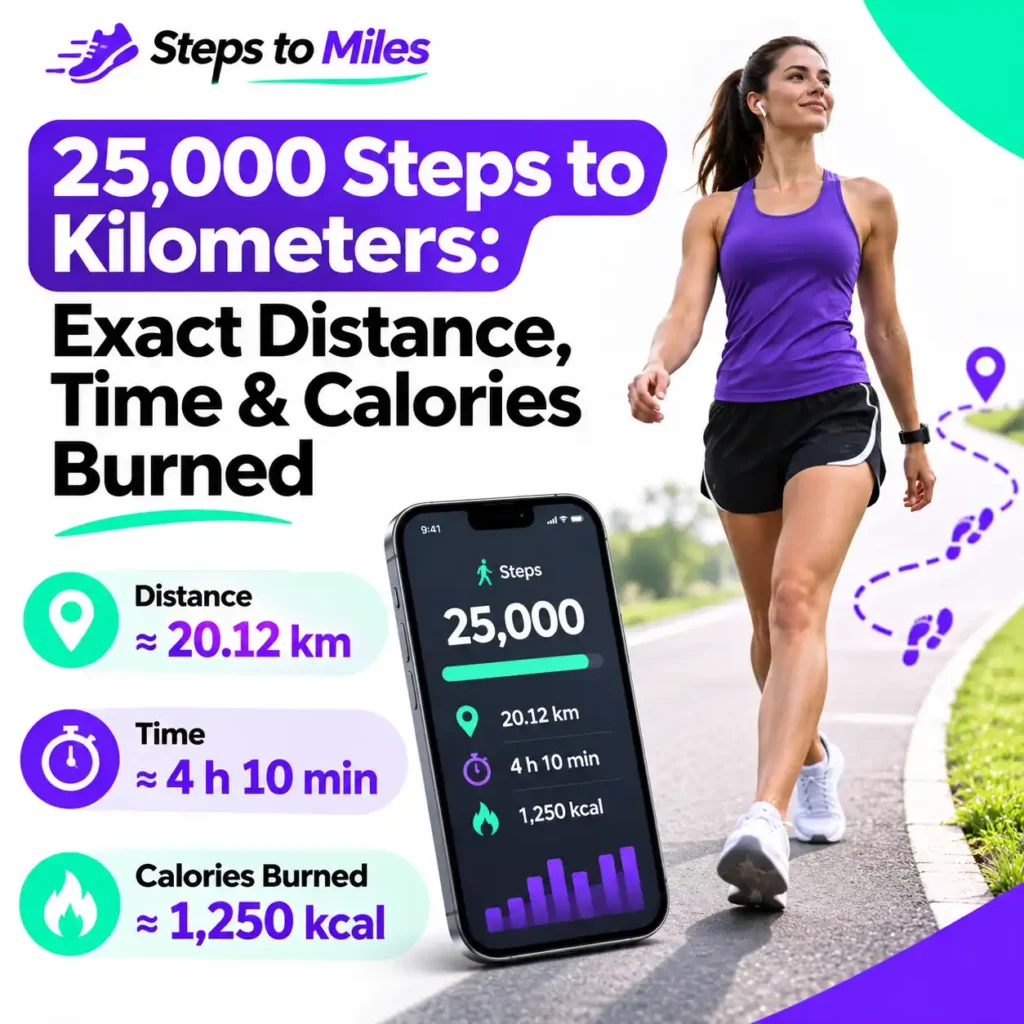
For the vast majority of adults, converting 25 000 steps to km equals roughly 17.5 to 19 kilometers. If we look at the global average, it lands right on 18.5 km.
To give you an idea of what that actually means, an official half-marathon is 21.1 km. You basically walked across an entire town. Just remember that your pedometer isn’t using a physical tape measure. Unless you manually turn on a GPS tracker, your phone just counts your hip movements and multiplies them by an estimated stride length. If you prefer to track your long-distance walks in imperial units, just drop your daily count into our step to miles calculator.
How Many Kilometers Is 25,000 Steps? (Quick Answer)
If you just want the raw numbers without any complicated math, 25,000 steps for an average adult walking at a normal pace is roughly 18.5 kilometers.
Why is there a gap between 17.5 and 19 km? Because no two bodies are exactly the same. The standard adult step length sits right around 0.74 meters. Multiply 25,000 steps by 0.74 meters, divide by a thousand, and you get exactly 18.5 kilometers.
Average Distance Breakdown for Men vs. Women
Men and women usually see different kilometer readouts on the exact same step count. It all comes down to natural differences in average standing height.
Guys typically have a stride length of about 0.76 meters. A man hitting 25,000 steps usually covers 19.05 kilometers. Taller guys walking with an active, aggressive pace can easily push past 20 kilometers.
Women average a slightly shorter stride of about 0.67 meters. A woman walking 25,000 steps generally hits 16.75 kilometers. Taller women with a longer natural stride will see their numbers bump up closer to 17.5 or 18 kilometers.
How Your Height and Stride Length Affect the Final Distance
Height changes pedometer math completely. Taller individuals naturally take longer strides. Shorter folks take quicker, more compact steps just to maintain the exact same walking speed.
Imagine two friends walking the exact same trail until their watches buzz at 25,000 steps.
- Friend A is 5'2" (157 cm). Her natural step is about 0.65 meters, meaning she traveled 16.25 kilometers.
- Friend B is 6'2" (188 cm). His natural step is about 0.78 meters, meaning he traveled 19.50 kilometers.
They both put in the exact same amount of steps, but Friend B covered three extra kilometers of actual ground. You can check how your specific frame alters these numbers on our steps to miles by height page.
How Long Does It Take to Walk 25,000 Steps?
You cannot fake time. Walking nearly 19 kilometers requires a massive chunk of your day. It is definitely not something you squeeze into a quick lunch break.
Time Taken at Casual Walking Pace vs. Brisk Pace
Your walking cadence—how many steps your feet take every sixty seconds—completely dictates the clock.
- Casual pace (80 steps per minute): This is the speed you use while window shopping, wandering through a museum, or walking a dog. Knocking out 25,000 steps at this speed takes about 5 hours and 12 minutes.
- Normal pace (100 steps per minute): A steady, purposeful pace down a sidewalk drops the time down to roughly 4 hours and 10 minutes.
- Brisk pace (120 steps per minute): This means you are power-walking fast enough to break a light sweat. You will finish in roughly 3 hours and 28 minutes.
Want to map out your times for smaller daily routines? Check our steps to minutes breakdown.
Running vs. Walking Time Comparison
Running completely alters your body mechanics. When you jog, both feet physically leave the pavement for a split second, which stretches your stride out significantly.
An average runner takes 160 to 170 steps a minute. That finishes 25,000 steps in about 2 hours and 30 minutes. Because running strides stretch out to 1.0 or 1.2 meters, running 25,000 steps actually covers roughly 25 to 28 kilometers instead of the usual 18.5 kilometers you get from walking.
Calories Burned Walking 25,000 Steps
Walking 18.5 kilometers burns serious physical fuel. Most people burn somewhere between 850 and 1,500 calories during a 25k day.
How Body Weight and Pace Influence Total Calorie Burn
Your scale weight is the primary engine behind your calorie burn. Moving a heavier frame across the earth simply demands more mechanical energy.
- 130 lbs (59 kg): Burns roughly 800 to 950 calories.
- 160 lbs (73 kg): Burns roughly 1,000 to 1,200 calories.
- 190 lbs (86 kg): Burns roughly 1,200 to 1,450 calories.
- 220 lbs (100 kg): Burns roughly 1,400 to 1,700 calories.
Check our steps to calories calculator to see how different step targets affect your daily energy burn.
Is 25,000 Steps a Day Effective for Weight Loss?
Absolutely. Burning a bonus 1,000 calories creates a massive energy deficit. But you have to be smart about it.
Spending four hours on your feet triggers intense hunger spikes. If you walk 25,000 steps and immediately eat a massive fast-food meal because you feel starved, you erase the deficit completely. Most people see much better, sustainable fat loss by holding a steady 10,000 to 12,000 steps a day rather than wrecking their feet with a massive 25k hike and sitting on the couch for the next three days recovering.
Quick Steps to Kilometers Conversion Chart (1,000 to 50,000 Steps)
People are constantly tracking weirdly specific numbers on their phones. We mapped out everything from a short walk down the driveway to extreme endurance goals. Here is exactly how those numbers convert using a standard 0.74m adult stride:
| Step Count | Distance in Kilometers | Step Count | Distance in Kilometers |
|---|---|---|---|
| 200 steps in km | 0.15 km | 22500 steps in km | 16.65 km |
| 2000 steps in km | 1.48 km | 22600 steps in km | 16.72 km |
| 2200 steps in km | 1.63 km | 23000 steps in km | 17.02 km |
| 2500 steps in km | 1.85 km | 23500 steps in km | 17.39 km |
| 2700 steps in km | 2.00 km | 24000 steps in km | 17.76 km |
| 5200 steps in km | 3.85 km | 24500 steps in km | 18.13 km |
| 8000 steps in km | 5.92 km | 26000 steps in km | 19.24 km |
| 8200 steps in km | 6.07 km | 26500 steps in km | 19.61 km |
| 9200 steps in km | 6.81 km | 27k steps in km | 19.98 km |
| 11200 steps in km | 8.29 km | 28000 steps in km | 20.72 km |
| 12200 steps in km | 9.03 km | 28500 steps in km | 21.09 km |
| 17000 steps in km | 12.58 km | 29000 steps in km | 21.46 km |
| 19000 steps in km | 14.06 km | 32500 steps in km | 24.05 km |
| 20k steps in km | 14.80 km | 35000 steps in km | 25.90 km |
| 20400 steps in km | 15.10 km | 42000 steps in km | 31.08 km |
| 20600 steps in km | 15.24 km | 47000 steps in km | 34.78 km |
| 21000 steps in km | 15.54 km | 52000 steps in km | 38.48 km |
| 21200 steps in km | 15.69 km | 82000 steps in km | 60.68 km |
| 21500 steps in km | 15.91 km | 200000 steps in km | 148.00 km |
| 22000 steps to km | 16.28 km | 250000 steps in km | 185.00 km |
| Step Count | Distance in Kilometers |
|---|---|
| 200 steps in km | 0.15 km |
| 2000 steps in km | 1.48 km |
| 2200 steps in km | 1.63 km |
| 2500 steps in km | 1.85 km |
| 2700 steps in km | 2.00 km |
| 5200 steps in km | 3.85 km |
| 8000 steps in km | 5.92 km |
| 8200 steps in km | 6.07 km |
| 9200 steps in km | 6.81 km |
| 11200 steps in km | 8.29 km |
| 12200 steps in km | 9.03 km |
| 17000 steps in km | 12.58 km |
| 19000 steps in km | 14.06 km |
| 20k steps in km | 14.80 km |
| 20400 steps in km | 15.10 km |
| 20600 steps in km | 15.24 km |
| 21000 steps in km | 15.54 km |
| 21200 steps in km | 15.69 km |
| 21500 steps in km | 15.91 km |
| 22000 steps to km | 16.28 km |
| 22500 steps in km | 16.65 km |
| 22600 steps in km | 16.72 km |
| 23000 steps in km | 17.02 km |
| 23500 steps in km | 17.39 km |
| 24000 steps in km | 17.76 km |
| 24500 steps in km | 18.13 km |
| 26000 steps in km | 19.24 km |
| 26500 steps in km | 19.61 km |
| 27k steps in km | 19.98 km |
| 28000 steps in km | 20.72 km |
| 28500 steps in km | 21.09 km |
| 29000 steps in km | 21.46 km |
| 32500 steps in km | 24.05 km |
| 35000 steps in km | 25.90 km |
| 42000 steps in km | 31.08 km |
| 47000 steps in km | 34.78 km |
| 52000 steps in km | 38.48 km |
| 82000 steps in km | 60.68 km |
| 200000 steps in km | 148.00 km |
| 250000 steps in km | 185.00 km |
Kilometers aren’t always the best measurement, especially if you need smaller units or vertical counts. Here is the math for those specific situations:
- How many meters is 2000 steps? Roughly 1,480 meters on average.
- 20000 steps in meters: This multiplies out to exactly 14,800 meters.
- How many feet is 6000 steps? Using standard imperial math, men cover roughly 15,000 feet, while women cover roughly 13,200 feet.
- How many flights is 2000 steps (and how many stories is 2000 steps)? An architectural flight of stairs typically holds 15 steps. Climbing 2,000 individual stair steps vertically equals roughly 133 flights of stairs. That is the equivalent of climbing 133 building stories.
How to Accurately Calculate Your Personal Stride Length
Your phone simply guesses your step size based on your height profile. If you want totally accurate kilometer readings, measure your actual stride on your own. It takes two minutes.
Go to a flat driveway or sidewalk and mark a starting line. Walk 20 normal steps. Do not stretch your legs out trying to cover extra ground. Stop on step 20 and mark where your front toe landed. Measure the total distance and divide it by 20.
If your 20 steps covered 14.8 meters, 14.8 divided by 20 equals 0.74 meters. You can type that exact number straight into your fitness app settings for perfect tracking.
Is Walking 25,000 Steps a Day Safe and Beneficial?
Walking is fantastic because it has very low joint impact compared to running. But 25,000 steps is still an extreme volume. Your feet are hitting the ground over 12,000 times each.
Key Health Benefits of High Daily Step Counts
Long walks act like a massive sponge for your blood sugar. Your leg muscles pull glucose straight out of your blood. Moving at an easy pace for four hours also strengthens your heart without spiking your stress hormones the way high-intensity interval workouts do. Plus, walking outside clears your head. Getting away from your screens for a few hours drops your cortisol levels naturally.
Tips to Avoid Overtraining and Fatigue
Shoe foam flattens out fast. Walking 18.5 km a day ruins a pair of sneakers in less than two months. Watch your footwear carefully. Also, always wear synthetic socks. Cotton holds onto sweat, and walking 25,000 steps in damp cotton socks guarantees nasty heel blisters. Most importantly, pace your progress. Don’t jump from a 5,000-step average straight to 25,000 tomorrow. Your Achilles tendons need time to adapt, so add just a few thousand steps a week.
Frequently Asked Questions
Yes. It is a massive number. Health researchers classify anyone logging over 12,500 steps a day as "highly active." Hitting 25,000 steps literally doubles that top-tier active category.
It comes out to roughly 11.5 miles for an average adult. If you want to dive into the imperial numbers, take a look at our full 25000 steps to miles guide.
Yes. When you run, your stride physically stretches out. Running 25,000 steps covers roughly 25 to 28 kilometers, compared to the 18.5 kilometers you get from walking.
Final Words
Finishing the day with a massive 25,000 steps on your tracker means you just put roughly 17.5 to 19 kilometers of pavement behind you. You burned well over 1,000 calories and likely stayed on your feet for around four solid hours. Take a minute to measure your exact stride length so your watch stays accurate, keep your walking shoes fresh, and definitely put your feet up and rest tonight. You earned it.