
Miles to Steps Calculator: Convert Miles, Km & Meters to Steps
Say you’ve mapped out a 3 mile loop round the park and your watch only counts steps. How many should you expect? Most adults need somewhere between 2,000 and 2,500 steps for each mile, so roughly 6,000 to 7,500 for the loop. A miles to steps conversion calculator will do that sum for you. It’s still worth knowing what the calculator is doing, because your own stride can push the answer well off the average.
Below you’ll find the formula, a couple of charts and the distances people ask about most, from one mile up to a marathon. There’s a section for kilometers, meters, feet and yards too, plus a quick way to measure your own stride so you’re not stuck with an average. If you need to go the other way, our steps to miles calculator turns steps back into distance.
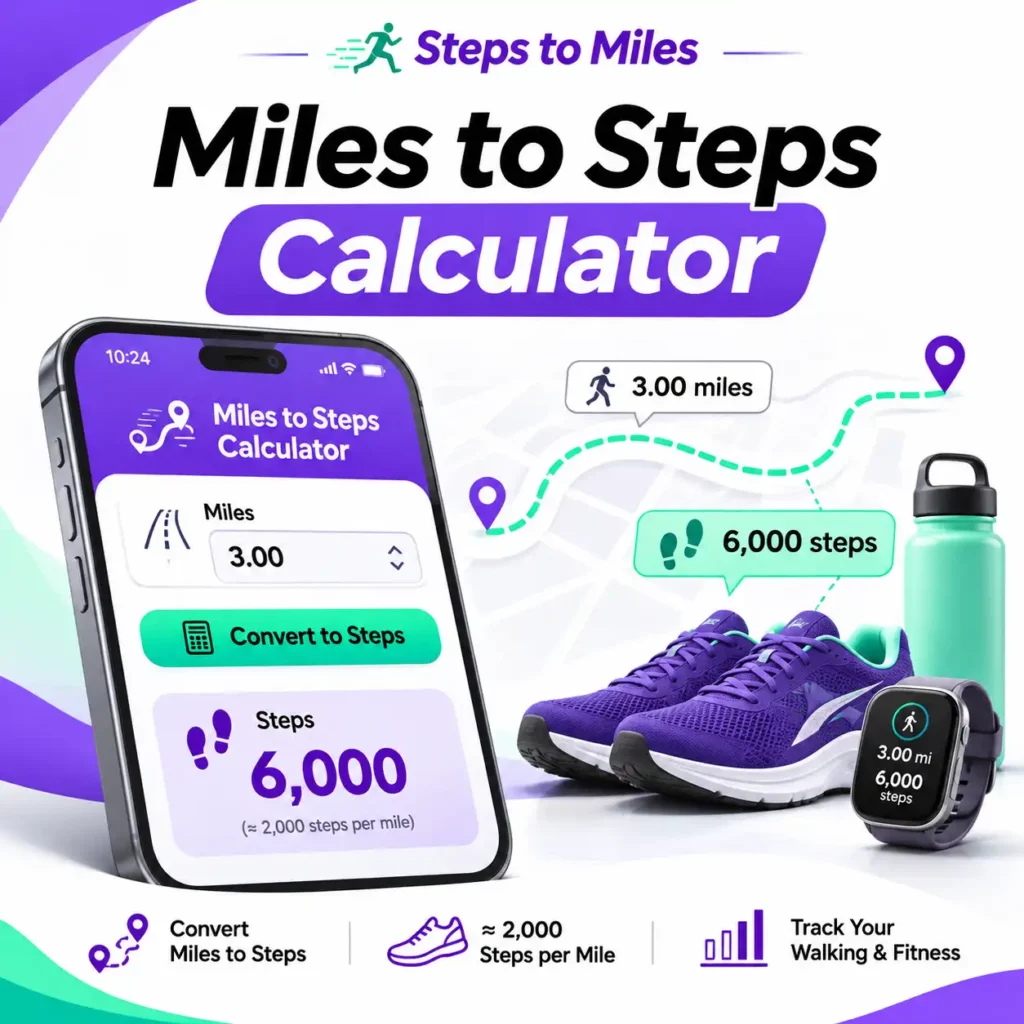
How Many Steps Are in a Mile?
A mile is 5,280 feet. How many steps it takes to cover that depends on your stride, which is simply how far you travel with each step. A 2.5 foot stride needs 2,112 steps. A 2.1 foot stride needs about 2,514. That gap is where the 2,000 to 2,500 range you see everywhere comes from.
Height drives most of it. Long legs, long steps, fewer of them. Speed has a say as well, because you reach further when you hurry. Compare someone ambling through a mall with a commuter late for a train and the commuter gets through the mile in fewer steps.
Plenty of people just use 2,000 a mile because it’s an easy number. As a rough guide it’s fine. It does make you look a bit fitter than you are if your steps run short, though. I’d use your own number when you have it, and the stride section below shows you how to find it.
Miles to Steps Conversion Chart
Here are miles converted to steps at two strides. The long-stride column uses 2,000 steps per mile and the short-stride column uses 2,500. Where you actually land is probably somewhere in between.
| Miles | Long stride (2,000 steps per mile) | Short stride (2,500 steps per mile) |
|---|---|---|
| 0.2 | 400 | 500 |
| 0.5 | 1,000 | 1,250 |
| 1 | 2,000 | 2,500 |
| 1.5 | 3,000 | 3,750 |
| 1.75 | 3,500 | 4,375 |
| 2 | 4,000 | 5,000 |
| 2.5 | 5,000 | 6,250 |
| 3 | 6,000 | 7,500 |
| 3.1 (5K) | 6,200 | 7,750 |
| 4 | 8,000 | 10,000 |
| 5 | 10,000 | 12,500 |
| 6.2 (10K) | 12,400 | 15,500 |
| 10 | 20,000 | 25,000 |
| 13.1 (half marathon) | 26,200 | 32,750 |
| 26.2 (marathon) | 52,400 | 65,500 |
Bigger distances scale the same way.
| Miles | Long stride (2,000 steps per mile) | Short stride (2,500 steps per mile) |
|---|---|---|
| 20 | 40,000 | 50,000 |
| 25 | 50,000 | 62,500 |
| 35 | 70,000 | 87,500 |
| 50 | 100,000 | 125,000 |
| 70 | 140,000 | 175,000 |
| 100 | 200,000 | 250,000 |
| 200 | 400,000 | 500,000 |
| 500 | 1,000,000 | 1,250,000 |
How to Convert Miles to Steps (Formula)
Doing it by hand takes one formula. This is how to convert miles to steps:
Steps = Distance in feet ÷ Stride length in feet
Three steps get you there.
Find Your Stride Length
Start with your stride length, the distance of one step. Don't know it? Estimate. Multiply your height in inches by 0.413 and you have the stride in inches. Divide by 12 for feet. At 5 ft 7 in (67 inches) that comes to 27.7 inches, or 2.31 feet. Height moves this number more than you'd expect, and our page on steps to miles by height shows by how much.
Convert the Distance to Feet or Inches
Next, put your distance in feet. One mile is 5,280 feet, so 2 miles is 10,560. If you're starting with kilometers, multiply by 3,280.84. With meters, multiply by 3.281.
Divide Distance by Stride Length
Now divide. 10,560 feet by a 2.31 foot stride gives about 4,570 steps for 2 miles. If you want to convert miles into steps and the distance has a decimal, multiply first and divide second. For 2.5 miles that's 2.5 × 5,280, which is 13,200 feet. Then 13,200 ÷ 2.31 gives roughly 5,714 steps.
How to Measure Your Actual Stride Length
The formula gives you an estimate. A measurement gives you your number. Here are two ways to get it, and both are easy.
First, the 100 foot walk. Mark out 100 feet with a tape measure (a hallway or driveway is fine), walk it at your normal pace and count your steps. Do that three times and average the counts. If you land on 40, your stride is 2.5 feet and a mile takes about 2,112 steps.
Second, the track. Four laps of a standard 400 meter track is close to a mile, so count your steps over four laps and you’re done. No division at all.
Do it at the speed you’ll really walk. A stroll, a power walk and a jog all give different strides. Wear the shoes you actually walk in, too. And if you have a GPS watch, it may learn your stride from outdoor walks by itself, so check the settings before you do it all by hand.
Walking vs Running: Steps per Mile
Pace changes your stride, and your stride changes your step count. Run and you stretch out, so the same distance takes fewer steps. These are estimates for adults.
| Activity | Speed | Steps per mile |
|---|---|---|
| Walking | 2 to 4 mph | 2,000 to 2,500 |
| Jogging | 4.5 to 6.5 mph | 1,500 to 1,900 |
| Running | 5 to 9+ mph | 1,300 to 1,700 |
Over a long distance the difference is big. Ten miles of walking is 20,000 to 25,000 steps. Running it is nearer 13,000 to 17,000. If you mix both in one outing, work out each part on its own and add them up.
How Many Steps Are in Common Distances?
These are the distances that come up most. I’ve used 2,000 to 2,500 steps a mile throughout.
How Many Steps Is 1 Mile?
A mile is 2,000 to 2,500 steps, which at 100 steps a minute is 20 to 25 minutes. Smaller distances scale down the same way. .2 miles in steps is roughly 400 to 500, a bit under one lap of a 400 meter track. Seven laps comes to about 1.75 miles, so how many steps in 1.75 miles? Around 3,500 to 4,375.
How Many Steps Is 2 Miles?
Two miles takes 4,000 to 5,000 steps, or 40 to 50 minutes at a steady pace. It’s a popular daily target, probably because it fits into a lunch break.
How Many Steps Is 2.5 Miles?
Wondering “2.5 miles is how many steps?” The answer is 5,000 to 6,250, or about an hour of walking. Routes are rarely round numbers though, so here’s the in-between.
| Distance | Steps (2,000 to 2,500 per mile) |
|---|---|
| 2.1 miles | 4,200 to 5,250 |
| 2.2 miles | 4,400 to 5,500 |
| 2.25 miles | 4,500 to 5,625 |
| 2.3 miles | 4,600 to 5,750 |
| 2.4 miles | 4,800 to 6,000 |
| 2.6 miles | 5,200 to 6,500 |
| 2.7 miles | 5,400 to 6,750 |
| 2.75 miles | 5,500 to 6,875 |
| 2.8 miles | 5,600 to 7,000 |
| 2.9 miles | 5,800 to 7,250 |
| 3.25 miles | 6,500 to 8,125 |
How Many Steps Is 3 Miles?
Three miles is 6,000 to 7,500 steps. A 5K is a touch over at 3.1 miles, which comes to 6,200 to 7,750 steps if you walk it.
How Many Steps Is 5 Miles?
Five miles is 10,000 to 12,500 steps. That’s why a 10,000 step day usually ends up somewhere around 4 to 5 miles.
How Many Steps Is 10 Miles?
Ten miles is 20,000 to 25,000 steps and three to four hours on foot. Flip it around and 20,000 steps is 8 to 10 miles, which our page on covers.
How Many Steps Is a Marathon (26.2 Miles)?
Walk a marathon and you’re looking at about 52,400 to 65,500 steps. Runners take fewer, roughly 34,000 to 44,500.
Training distances work the same way. How many steps is 22 miles? Roughly 44,000 to 55,000. Stretch that to 25 miles and you’re at 50,000 to 62,500.
Kilometers, Meters, Feet & Yards to Steps
Metric works the same way. Turn the distance into miles, then multiply by your steps per mile.
How Many Steps Are in 1 Km?
A kilometer is 0.62 miles, so you'll need about 1,250 to 1,550 steps. Want to go the other way? Try our steps to km page.
How Many Steps Is 20 Km?
Charity hikes are often 20 km. How many steps is 20 kilometers? That's 12.4 miles, so 25,000 to 31,000 steps. Go bigger and the math stays the same. 200 km is about 124 miles, so how many steps is 200km? Roughly 250,000 to 310,000.
Meters, Feet & Yards to Steps
A mile has 1,609 meters, 5,280 feet or 1,760 yards. Divide your distance by the right number to get miles, then multiply. Take 2000 meters to steps. That's 1.24 miles, or about 2,490 to 3,110 steps. Feet are much smaller, so how many steps is 2000 feet? A bit over a third of a mile, around 760 to 950 steps. Yards sit in between: 6000 yards to steps works out at roughly 6,820 to 8,520.
| Distance | Steps (2,000 to 2,500 per mile) |
|---|---|
| 100 meters | 125 to 155 |
| 500 meters | 620 to 780 |
| 1,000 meters | 1,240 to 1,550 |
| 2,000 meters | 2,490 to 3,110 |
| 1,000 feet | 380 to 470 |
| 2,000 feet | 760 to 950 |
| 100 yards | 115 to 140 |
| 1,000 yards | 1,140 to 1,420 |
| 6,000 yards | 6,820 to 8,520 |
Why Convert Miles to Steps?
Trackers count steps. Routes and races are measured in miles. Converting between them lets you plan in one and measure in the other.
Say you want 10,000 steps and your usual loop is 2 miles. Two loops get you 8,000 to 10,000, and a short walk after dinner covers the rest. Or you’ve signed up for a 5K and want to know what your watch should read at the finish line. Both need a quick conversion. It’s also a decent way to test a tracker. Walk a distance you know, then compare the step count with what you’d expect.
Goals matter at every level. A modest 5,000 step day is still a couple of miles, and 5000 steps to miles has the exact figures. Official health advice, like the U.S. guideline of 150 minutes of moderate activity a week, is given in minutes rather than steps. Miles and steps help you picture what those minutes look like. After the walk, you can check your total in reverse with our guide on how to convert steps to miles.
Frequently Asked Questions
For most adults, 2,000 to 2,500. Tall people and fast walkers land near the low end. Shorter people land near the high end.
Not quite. Stride depends mostly on height, and men are taller on average, so their steps tend to be a bit longer. Two people of the same height come out close.
They sit in different places and read movement differently. A watch can count arm swing. A phone in a bag can miss steps. Test both over a measured distance before you trust either.
A 5K is 3.1 miles, or 6,200 to 7,750 steps. A 10K is 6.2 miles, or 12,400 to 15,500. Running takes fewer.
A half marathon is 13.1 miles, about 26,200 to 32,750 steps if you walk it.
Yes, it's the same multiplication. The Appalachian Trail is roughly 2,200 miles, or about 4.4 to 5.5 million steps. By the same rule, 2000 miles is 4 to 5 million steps and 3000 miles is 6 to 7.5 million. 5000 miles and 6000 miles come to 10 to 12.5 million and 12 to 15 million. Even 15000 miles works out at 30 to 37.5 million steps, and 20,000 miles at 40 to 50 million.